
Reviewed · SALALAH TOURS
East Salalah Highlights: Half-Day Heritage & Scenic Countryside
Salalah’s eastern countryside gives you a lot in half a day: a former governor’s home, ocean cliffs, a valley with waterfalls, rare baobab trees, and an ancient frankincense port. The most unusual stop is Tawi Attair, a huge limestone sinkhole known locally as the Well of Birds.
I like the mix of natural sights and Omani history, and I like that this is a private tour rather than a bus outing. The main consideration is the pace. Seven stops in four to five hours means some visits are brief, and Taqah Castle may still be under maintenance.
Key points to know before booking
- Taqah Castle may be closed for maintenance: Extra time is offered at the nearby cliff viewpoint if the castle cannot be visited.
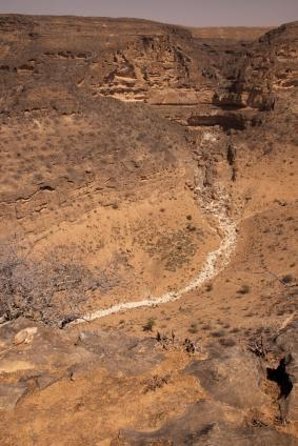
- The 211-meter Well of Birds is the tour’s strangest sight: You can look into the limestone opening and hear birds around its walls.
- Wadi Darbat changes with the season: Water activities and small waterfalls are especially associated with the period after the monsoon.
- Rare baobab trees grow on Samhan Mountain: Only about 200 are found in Dhofar, making this a valuable photo stop.
- The tour ends at UNESCO-listed Sumhuram: Its ruins connect Salalah to the old frankincense trade.
- Private transport adds comfort: The package includes an air-conditioned vehicle, water, fees, fuel, and an Arabic and English-speaking guide.
Why eastern Salalah works well as a half-day tour
This route is a strong introduction to Dhofar because it does not focus on only one type of sight. You move from the fishing town of Taqah to the Indian Ocean, then inland through valleys and mountain country before ending at an ancient port.
That variety matters in Salalah. A beach stop alone tells you little about the region’s past, while an archaeological site alone can feel dry if you have limited time. Here, the scenery gives context to the old settlements, farms, livestock routes, and frankincense trade that shaped eastern Dhofar.
The vehicle is air-conditioned, which matters in a warm climate and on a route with several road sections. For one to three adults, a two-wheel-drive vehicle is used. Groups of four to six use a four-wheel-drive vehicle, while seven to nine people are split between two four-wheel-drive vehicles with one guide and two drivers.
The advertised price is $170 per person. That is not a small amount for a half-day outing, but the price includes private transport, fuel, bottled water, entrance fees, and a guide. The value improves if you are sharing the vehicle with several people, since the tour is private and built around your own group rather than a large coach.
Other days around Salalah and Dhofar:
- East Salalah Mountain Safari, Wadi Darbat, Beach, Camels, Dunes
★ 5.0 · 206 reviews - Sunset Desert Safari Salalah Tour in Rub Al Khali – Empty Quarter
★ 5.0 · 91 reviews - Salalah: Sunset Desert Safari – Rub Al Khali – Empty Quarter
★ 4.6 · 79 reviews
Taqah Castle and the old fishing town
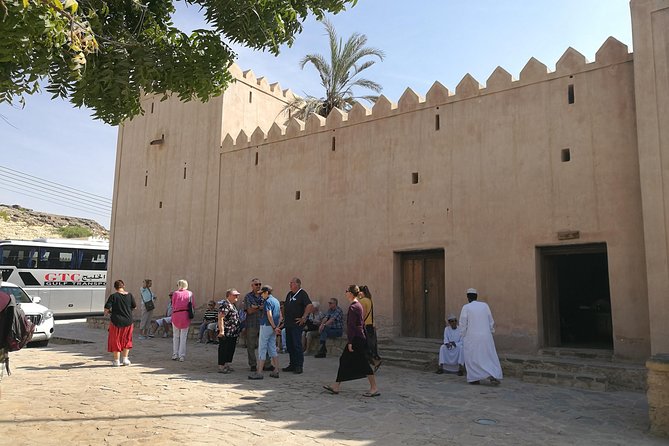
The first stop is Taqah, an old coastal town known for fishing, dried sardines, local harvests, and traditional Dhofari mud houses. This is useful background before you see the former residence of the town’s wali, or governor.
Taqah Castle is now used as a museum, with displays about earlier Omani life. A visit here helps you picture how authority, trade, and daily routines were organized before modern roads and hotels changed the coast.
You also pass the old fort or watchtower on a nearby hill. Even if you only see it from outside, its position explains the practical side of Taqah. Elevated lookout points were useful along a coast where fishing and maritime movement mattered.
There is one important catch. The castle is currently under maintenance. If it is not open when you arrive, the operator says you will receive extra time at Taqah Cliff instead. I would confirm the situation close to your travel date if the museum is a major reason for booking.
The scheduled castle visit takes about 45 minutes and includes admission when the site is available. For the best experience, listen for details about the wali’s role and local life rather than treating the building as just another photo stop.
Taqah Cliff and the Indian Ocean view
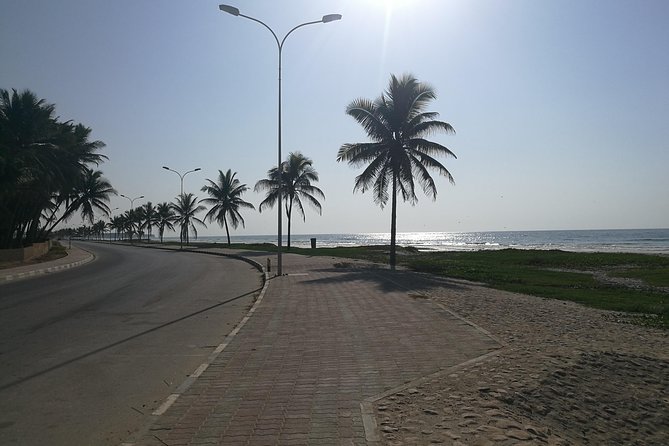
The next stop is a rocky cliff at the end of the Taqah coastline. The viewpoint rises about 15 meters above the coast and looks across the Indian Ocean toward Taqah.
You get roughly 20 minutes here. That is enough for photographs, a look at the shore, and some time in the sea breeze, but it is not a long coastal walk. The viewpoint is also described as a possible dolphin-watching spot. Dolphins are not guaranteed, so bring realistic expectations and use the stop mainly for the open ocean view.
This may become an especially important part of the route if Taqah Castle is closed. It is a simple stop, but it gives you a clear sense of the town’s setting. The contrast between the dry cliff, the sea, and the nearby settlement is one of the tour’s strongest visual moments.
Wadi Darbat, water, and seasonal changes
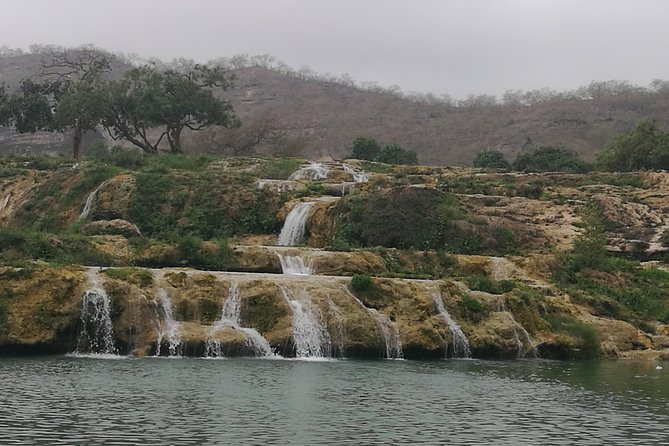
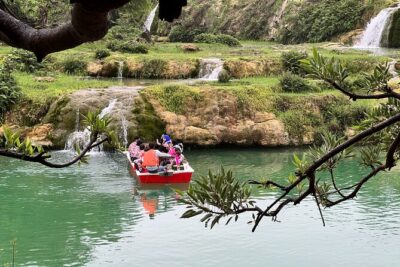
Wadi Darbat is the longest nature stop, with about an hour planned. The valley is known for a natural spring, an underground water source, a lake, small waterfalls, and open areas where local camels, cattle, and goats may be seen.
The character of Wadi Darbat depends on the season. After the monsoon, water activities such as pedal kayaking, speedboats, and kayak boats may be available. The valley can also show more flowing water and small falls at that time.
You should not expect the exact same scene on every visit. The information provided describes these activities as seasonal, so ask your guide what is operating on the day. The tour includes the stop, but it does not list water activities as included. Plan to treat them as optional extras unless the operator tells you otherwise.
I like that Wadi Darbat gives the tour a slower stretch. After the castle and cliff, you have time to look around a natural valley rather than rushing from one landmark to the next. Families may especially appreciate this stop, though the overall half-day schedule still leaves limited time for extended activities.
The valley is also a good place to notice how Dhofar’s countryside supports both people and animals. Camels, cattle, and goats are part of the scene, and the water makes the valley feel different from the drier mountain roads later in the route.
Other ways into the past around Salalah:
- Salalah City Tour with History, Culture, Souq Shopping, Halwa
★ 4.5 · 39 reviews - Historical Salalah City Tour
★ 4.7 · 22 reviews - Historical Salalah City Tour
★ 5.0 · 4 reviews - From Muscat: Nizwa and Oman’s Historical Gems Tour
★ 4.7 · 403 reviews
Tawi Attair and the Well of Birds
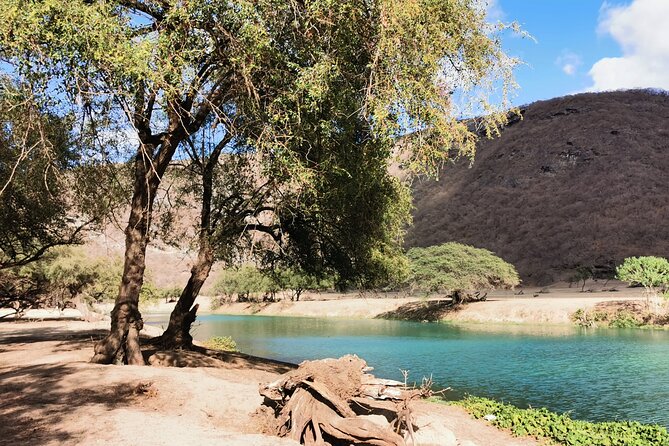
About 20 minutes after Wadi Darbat, the route continues through open countryside to Tawi Attair. The name Well of Birds refers to the birds that circle and nest around the limestone opening.
The sinkhole reaches about 211 meters deep, roughly the height of a 60-story building. You view it from a designated viewpoint while your guide explains the formation and points out the bird activity around the walls.
This is not a stop for anyone who dislikes heights. The information describes a large opening in a limestone plateau, so stay at the viewpoint and follow your guide’s directions. The stop lasts about 25 minutes, which is enough to take in the scale without turning it into a long walk.
I find this one of the most distinctive parts of the route because it is not simply a scenic overlook. The sound of birds echoing around a giant natural opening gives the place a character you cannot get from a standard mountain viewpoint. Still, the experience depends on visibility and bird activity, so do not expect a staged wildlife encounter.
Baobab trees on Samhan Mountain
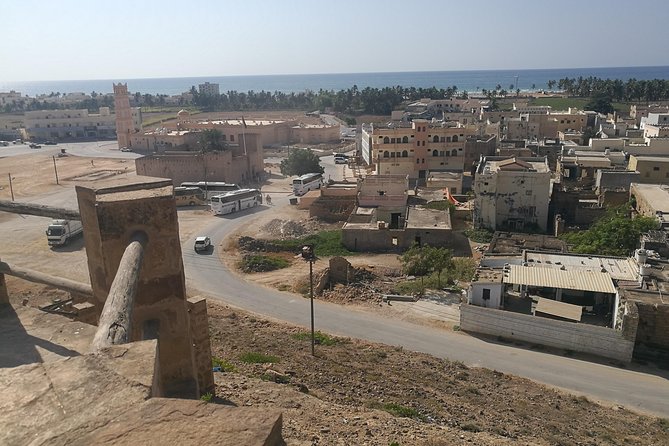
The next stop takes you to Wadi Hinnah on Samhan Mountain, where you can see giant tabaldi baobab trees. These trees are more commonly associated with Africa, especially Madagascar, but Dhofar has its own small population.
Around 200 baobab trees are found in Dhofar. They can reach about 25 meters in height and grow trunks up to two meters across. Locally, the tree is known as ankiji or al mashwa.
The scheduled stop is only 15 minutes, so this is mainly a photography and observation break. The short timing makes sense if the trees are close to the road, but you should not expect a long botanical walk or an extended forest visit.
Look closely at the trunk and shape of the tree. The unusual form is the point. This is also a good moment to ask your guide about the local name and how the tree fits into Dhofar’s natural setting. If you enjoy unusual plants, this may be more memorable than a standard scenic stop.
The Samhan gravity point
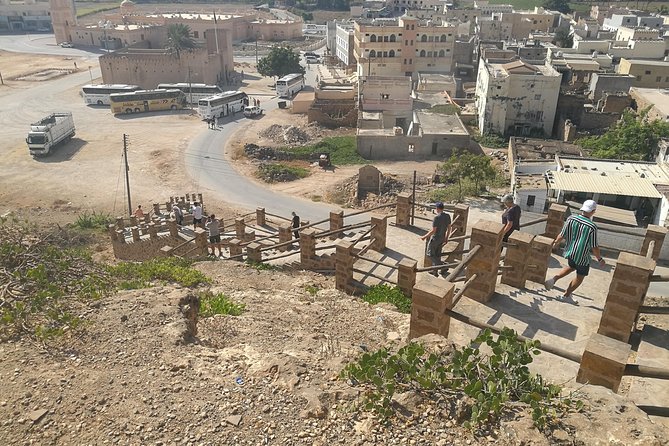
About 15 minutes farther down Samhan Mountain is the tour’s most playful stop. At the so-called gravity point, a vehicle placed in neutral appears to roll uphill along a bleak stretch of road.
The effect is described as a controversial natural mystery. You can experience it directly rather than relying on a photograph, but the tour does not provide a scientific explanation for why the road appears to rise in defiance of gravity.
Allow about 15 minutes. This is a curiosity stop, not a major attraction, and its appeal depends on how much you enjoy testing odd roadside phenomena. I would treat it as a light interlude between the baobab trees and Sumhuram, not as the main reason to book the tour.
Sumhuram, the ancient frankincense port
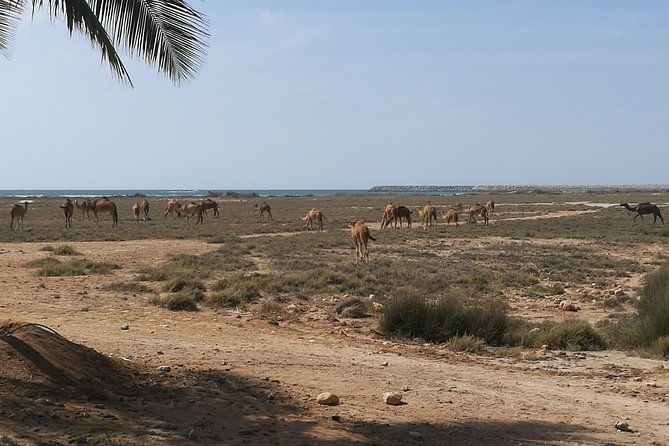
The final stop is Sumhuram Old City, a UNESCO World Heritage site on a small hill overlooking the Indian Ocean. The ruins date to around the 5th century BC and are connected with Dhofar’s old frankincense trade.
This is the most important historical stop of the day. Sumhuram was an ancient port, and its location helps explain why this coast mattered. Frankincense from Dhofar moved through regional trade networks, and a port overlooking the sea was central to that activity.
You have about an hour here, including time at the information center. A six-minute film provides an introduction to the ruins and helps put the remaining walls into context before you explore.
The site is more rewarding if you pay attention to its setting. You are not looking at an isolated collection of stones. You are seeing an old settlement positioned above the coast, in a region tied to one of the most important products of southern Arabia.
The tour includes admission fees, which makes this a straightforward final stop. Wear sensible shoes and bring water, though bottled water is provided. The exact walking conditions are not specified, so ask your guide if you need help planning for the ruins.
Guide style, transport, and group size
The package includes a local Arabic and English-speaking guide. One guide named in the supplied feedback is Hamid, who explained different periods of Oman’s past and added context at Taqah, the mountains, waterfalls, and local buildings. If Hamid is assigned to your group, you can expect history to be part of the experience rather than just a sequence of photo stops.
The private format is a real advantage. You can ask questions, spend longer at a viewpoint if conditions are good, and avoid being tied to a large group. The tradeoff is that the price may feel high for one person or a couple, especially since the tour lasts only four to five hours.
Pickup is available, and the vehicle is air-conditioned. Fuel surcharge, taxes, entrance fees, and bottled water are included. Anything not specifically listed should be treated as your own expense, including optional activities at Wadi Darbat.
Most people can participate, and confirmation is provided at booking. The experience requires good weather. If poor weather causes cancellation, you are offered another date or a full refund. You can cancel for a full refund up to 24 hours before the start time, but late changes are not accepted.
Who should book this Salalah tour?
I would choose this tour if you want a broad taste of eastern Salalah without giving up a private vehicle. It suits first-time visitors, families who want several easy sightseeing stops, and anyone interested in combining Omani history with unusual natural features.
It is also a good choice if Sumhuram, Taqah, and Wadi Darbat are all on your wish list. Organizing those places independently could require more planning, and the guide adds useful context at the historical sites.
I would look elsewhere if you want a slow day at one valley, a long beach visit, or extended time at each ruin. The route covers a lot of ground. The baobab stop is only 15 minutes, Tawi Attair about 25 minutes, and the cliff about 20 minutes.
Should you book East Salalah Highlights?
Book it if you value variety, private transport, and a guide who can connect Dhofar’s old towns, mountains, water sources, and frankincense trade. The best stops are Tawi Attair, Wadi Darbat, and Sumhuram, while the baobab trees add a rare botanical surprise.
Before paying, confirm whether Taqah Castle is open and ask what conditions are expected at Wadi Darbat. If the castle remains closed, the cliff viewpoint helps fill the gap, but you should book this for the full route rather than for the castle alone.
FAQ
How long does the East Salalah tour take?
The tour lasts approximately four to five hours.
Is hotel pickup available?
Yes. Pickup is offered for your convenience.
Is this a private tour?
Yes. Only your group participates in the activity.
What type of vehicle is used?
The tour uses an air-conditioned vehicle. One to three adults travel by two-wheel drive, four to six adults use a four-wheel drive, and groups of seven to nine use two four-wheel-drive vehicles with one guide and two drivers.
Is Taqah Castle open?
Taqah Castle is currently under maintenance. If it cannot be visited, extra time is offered at the nearby Taqah Cliff viewpoint.
Are entrance fees included?
Yes. All fees and taxes are included, along with admission to the listed ticketed sites.
Are activities at Wadi Darbat included?
The tour includes the Wadi Darbat visit, but seasonal activities such as pedal kayaking, speedboats, and kayak boats are not listed as included.
What languages does the guide speak?
The tour includes a local Arabic and English-speaking guide.
What is the cancellation policy?
You can cancel at least 24 hours before the start time for a full refund. Cancellations or changes made less than 24 hours before the start time are not refunded or accepted. If poor weather causes the tour to be canceled, you are offered another date or a full refund.
More half days out of Salalah
- Explore Samhan Mountain – Half-Day Getaway with Lunch Included.
★ 5.0 · 10 reviews - Half-Day Private Salalah East Tour
★ 5.0 · 3 reviews - Muscat: Half-Day Sightseeing Essentials Tour and Audio Guide
★ 4.2 · 598 reviews - Khasab: Half-Day Dhow Cruise, Dolphin Watching, & Snorkeling
★ 4.9 · 507 reviews
Just added in Salalah
- West of Salalah private tour – fascinating mountains and beaches★ 5.0 · 9 reviews
- West Salalah Beaches and Blowholes★ 5.0 · 7 reviews
- Private tour – Empty Quarter desert adventure – Wadi Dawka + Ubar★ 5.0 · 5 reviews
- West Salalah Tour by VisitSalalah★ 5.0 · 6 reviews
- Full-Day Private Salalah West Tour with Lunch★ 5.0 · 12 reviews
- Explore Samhan Mountain – Half-Day Getaway with Lunch Included.★ 5.0 · 10 reviews
- Where Sea Meets Rock: A Scenic Journey to West Salalah’s Shores★ 5.0 · 5 reviews
- Salalah East Tour (Full Day Tour)★ 5.0 · 3 reviews
Salalah Tours, compared.
East Salalah Mountain Safari, Wadi Darbat, Beach, Camels, Dunes
Read our review →
Sunset Desert Safari Salalah Tour in Rub Al Khali – Empty Quarter
Read our review →
West Salalah Tour – Caribbean of Orient – Fazayah Beach with City
Read our review →
West Salalah: Caribbean of the Orient Fazayah Beaches & City
Read our review →
Salalah City Tour: Discover the Best of Oman’s Coastal Gem
Read our review →
Sunset desert safari tour in Salalah(private tour)
Read our review →
East & West Salalah Combination Tour – Darbat Waterfall, Mughsail
Read our review →
Browse the lists this tour appears in